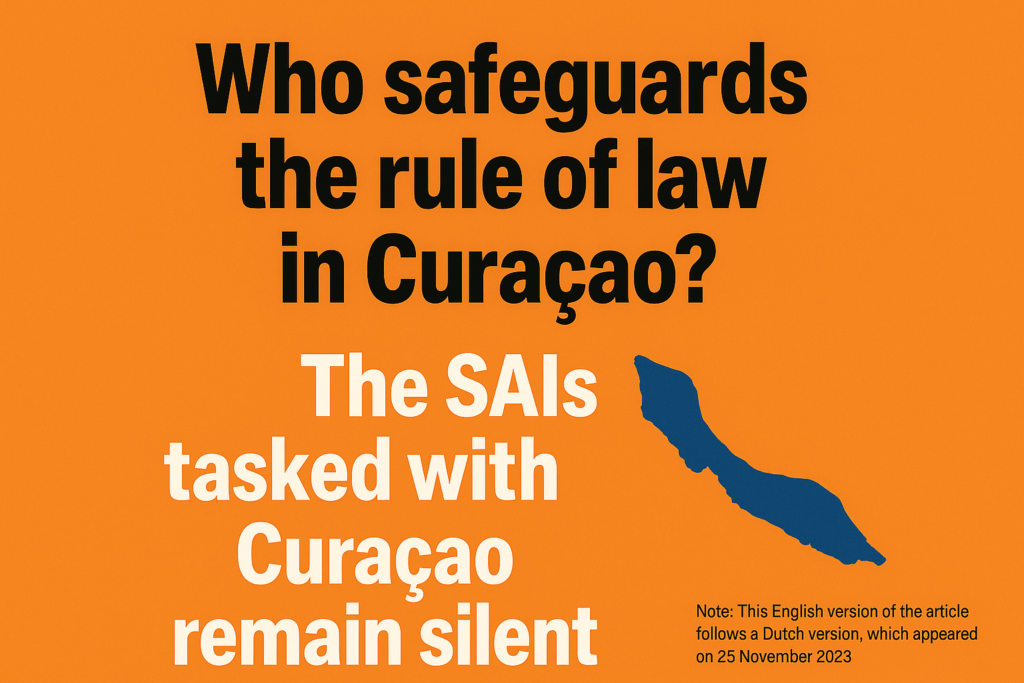
Lack of Oversight in the Kingdom — As Curaçao’s SAI Remains Silent
By Stanley Bodok
December 2, 2025
Who Tests the Effectiveness of Millions in Rule-of-Law Investments in Curaçao?
Curaçao’s rule-of-law challenges have come into sharper focus with the latest report of the Council for Law Enforcement, which shows that the island lacks adequate control over illegal firearms and the illicit arms trade. This is not a marginal issue, but a fundamental threat to public safety and the functioning of the rule of law. Yet despite years of substantial Kingdom-funded investments in justice and governance, no independent performance audit has ever assessed whether these efforts actually produce measurable improvements for citizens. This absence of systematic oversight—particularly by Curaçao’s Supreme Audit Institution—has created a critical gap in accountability within the Kingdom framework.
A Long-Standing Risk Without Independent Assessment
The problem is not new. Curaçao has struggled for years with the proliferation of illegal firearms and the risks this poses to public order. Yet at no point has it been examined whether the considerable Dutch investments in law enforcement and rule-of-law strengthening address such fundamental threats. The gap between spending and outcomes remains untested.
Evaluations That Avoid the Essentials
The recent DSP-group evaluation of the Dutch article-1 rule-of-law programme focuses largely on administrative processes in The Hague. What is missing are answers to three essential questions that any modern accountability chain would consider basic:
1. Do the resources spent in Curaçao actually achieve results?
2. Do citizens and professionals experience improvements?
3. Are urgent risks—such as illicit firearms—being effectively addressed?
Local voices were not included: not Members of Parliament in Curaçao, not civil society, not professionals. As a result, the evaluation omits what should be a cornerstone of every rule-of-law assessment: an examination of what citizens actually experience.
A Lack of Oversight Within the Kingdom
Curaçao’s Supreme Audit Institution (ARC) has conducted virtually no performance audits for almost a decade.
There are no authoritative public assessments of:
- anti-poverty policies
- education outcomes
- inspections and regulatory systems
- public health protection
- or the hospital project that has burdened public finances for years
The Netherlands Court of Audit (ARN) has likewise not examined whether Dutch funds are used effectively in Curaçao — even though it regularly supports and contributes to performance audit work in countries outside the Kingdom.
The result is striking: within the Kingdom, no independent institution systematically evaluates whether rule-of-law investments achieve their intended impact.
This exposes the limits of a narrow, bureaucratic understanding of “rule-of-law strengthening.”
A modern rule of law is more than institutional processes: it must protect citizens against violence, poverty, and failing public services.
Financial Supervision Without Performance Assessment
For fifteen years, the Kingdom’s Board for Financial Supervision (CFT) has monitored Curaçao’s public finances. But its mandate is strictly financial: it reviews budgets—not whether spending delivers results.
Practice shows that this has not led to sustainable financial recovery.
Moreover, as early as 2019, the Netherlands Court of Audit warned that the deployment of millions in Dutch taxpayers’ money has not demonstrated the expected effectiveness.
Even that structural signal has received no follow-up.
Who Can Make the Difference?
1. The Dutch Parliament
Dutch MPs bear responsibility for safeguarding Dutch taxpayers’ money.
They can request the Netherlands Court of Audit to conduct a full performance audit—ideally in cooperation with Curaçao’s SAI.
This requires a willingness to move beyond the reflex that deeper oversight in Curaçao is “colonial.”
The more relevant question is:
Is it morally defensible to look away while citizens in Curaçao face failing oversight and an illicit arms market that heightens their risk of becoming victims of violence?
2. The Netherlands Court of Audit (ARN)
The ARN can clarify that effectiveness cannot be assumed—it must be established through independent performance audit work.
This is not a political stance, but a core principle of modern Supreme Audit Institutions.
By acting accordingly, the Court visibly positions itself as independent from political considerations.
3. The Ombudsman of Curaçao and the National Ombudsman
These institutions hear daily what citizens experience.
They can alert parliaments and audit institutions to systemic failures that remain invisible without performance audits.
Their signals can help trigger the accountability chain that the Kingdom currently lacks.
International Expertise as a Legitimacy Buffer
A performance audit can be carried out by the ARN and ARC, supplemented where needed by international audit experts.
This approach strengthens technical quality and reduces political tensions—especially relevant when cross-jurisdiction oversight risks being interpreted as politically sensitive.
It also aligns with the international direction of the revised SAI PMF, which increasingly emphasises independence, quality management, and performance orientation across SAIs worldwide.
Towards a Mature Rule-of-Law Accountability Chain
As long as no one examines what tens of millions in rule-of-law funding actually produce, policy remains built on assumptions rather than evidence.
An independent performance audit is not a luxury—it is the missing link in the Kingdom’s oversight chain.
The Council of State recently urged the Kingdom to clarify which rule-of-law values must be protected and who must ensure their protection. Without independent assessment, that call remains unanswered.
Even the paper on which the Charter is written is growing impatient.
—-
About the author
Stanley Bodok is a Curaçaoan citizen and a graduate Freelance Writer and Journalist from the British College of Journalism, with a special focus on governance and public health. He has more than thirty years of experience in public administration.
===
Leave a Reply